Research
Chiraltronics: Material, Transport, and Device |
Novel Channels and 3D Nanoelectronics |
Cryogenic & Future Electronics
Chiraltronics: Material, Transport, and Device
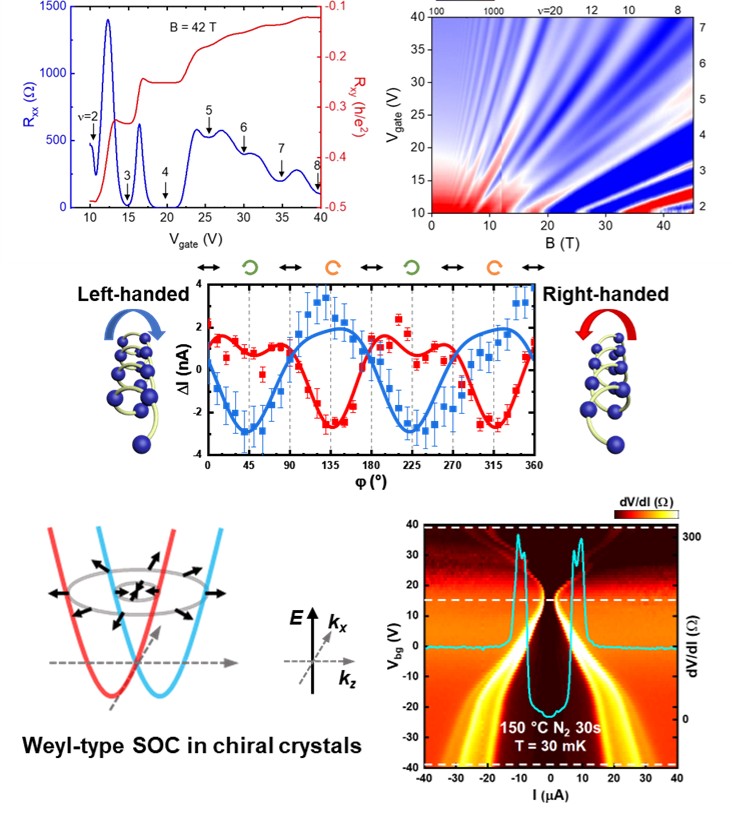
Quantum Hall Effect, Nonlinear Transport, Chirality-Induced Spin and Magnetic Effects.
Chiral quantum materials—those lacking inversion or mirror symmetry, are a rapidly emerging frontier in condensed matter physics due to their ability to host exotic quantum phenomena inaccessible in centrosymmetric systems. Their symmetry-breaking nature enables novel control over spin, charge, and heat transport, paving the way for energy-efficient logic, spintronics, and hybrid quantum technologies.
By combining precise device fabrication with low-temperature measurements, we explore topological and quantum properties of electrons intrinsic to chiral materials.
Novel Channels and 3D Nanoelectronics
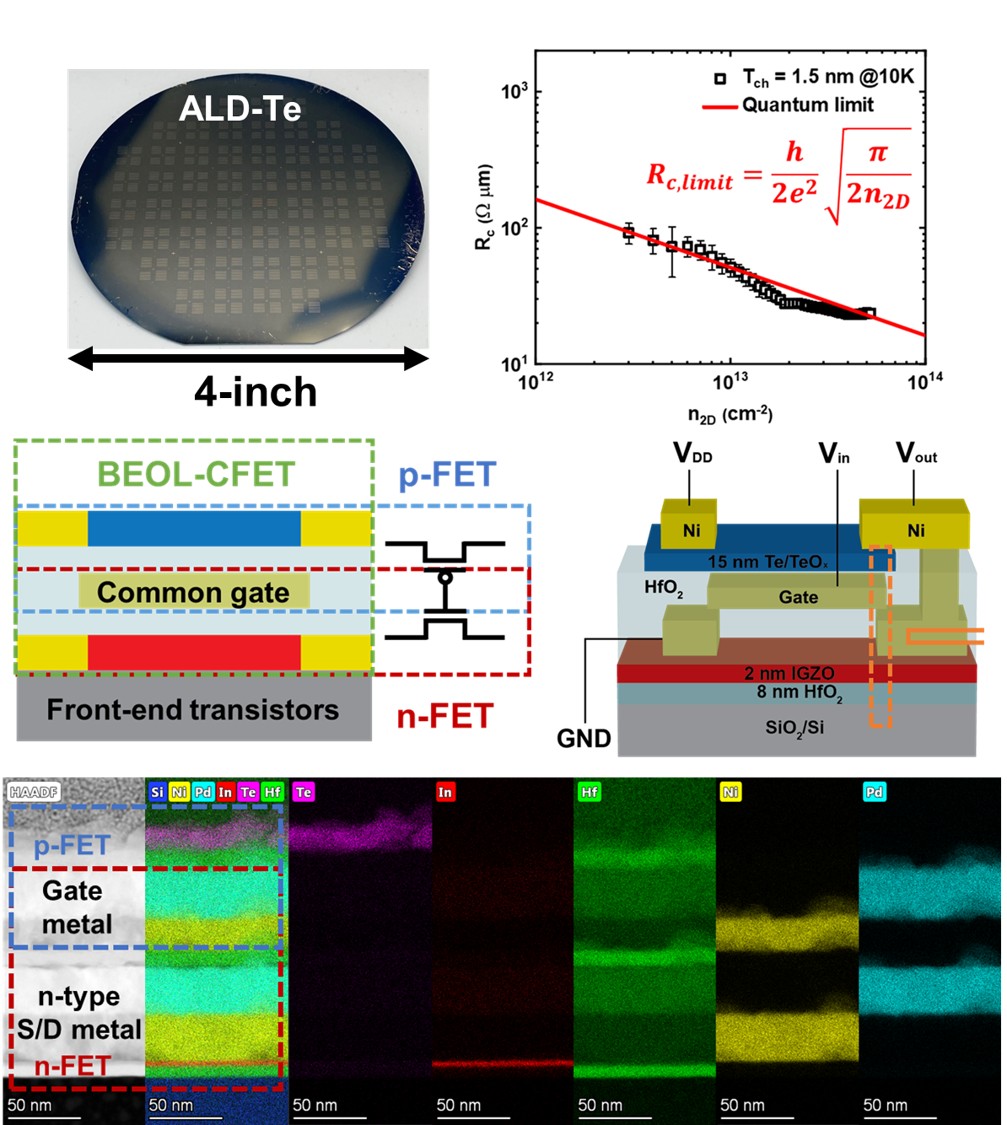
Atomic Layer Deposition, Oxide Semiconductors, P-Type Channel Materials, Monolithic Integration.
We develop and study ALD thin films channel materials such as InOx
and Te for next-generation back-end-of-line (BEOL) compatible applications. ALD offers precise
thickness control and excellent uniformity, enabling large-area integration
on various substrates.
Our work begins with fundamental device physics and pushes the limits of transistor behavior. By carefully managing thermal budgets and combining process optimization with detailed device characterization, we aim to achieve high mobility, low contact resistance, and excellent reliability in BEOL transistors.
Cryogenic & Future Electronics
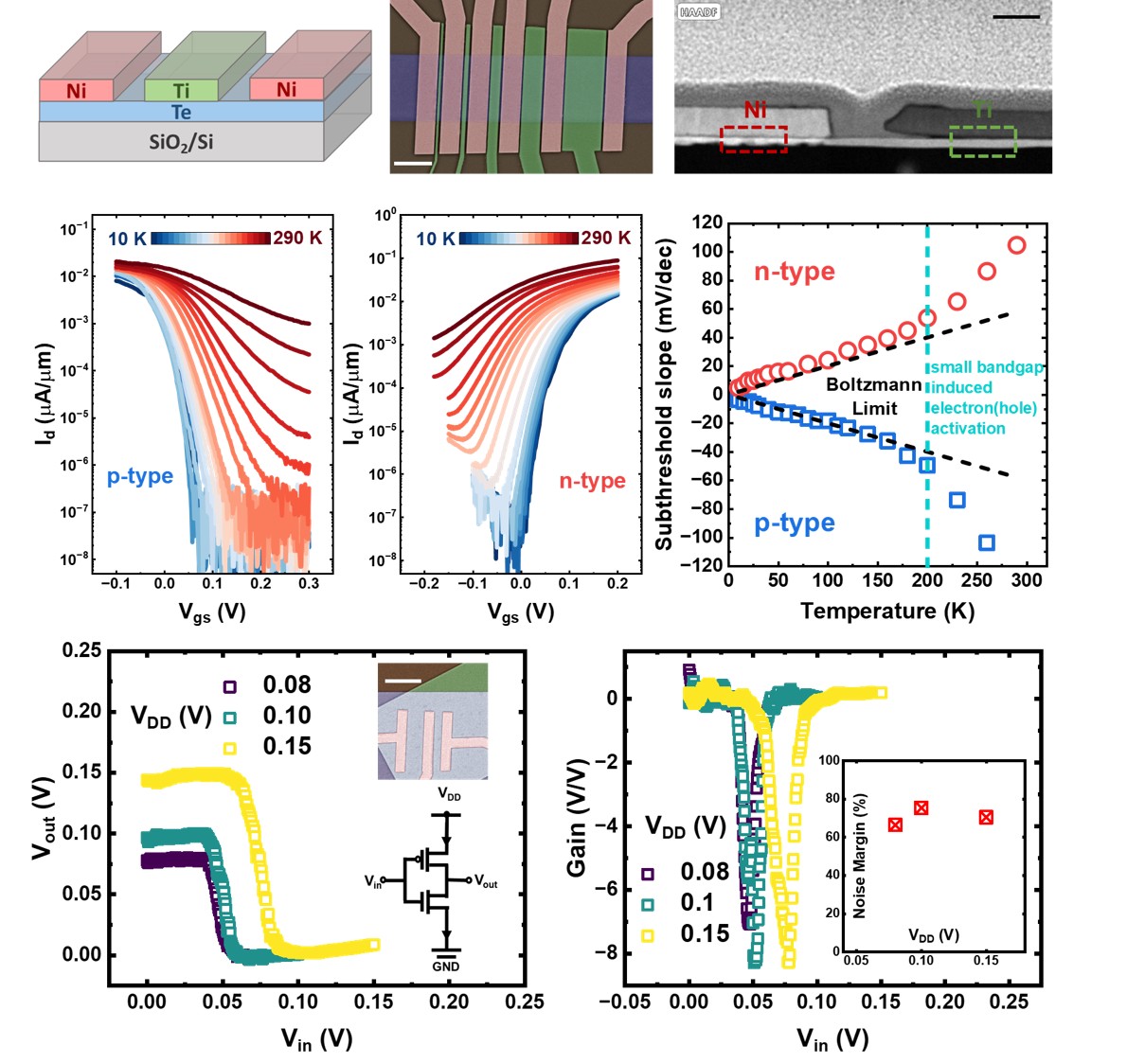
Electronics that operate at extreme temperatures and interface with quantum systems.
Future computing systems will increasingly integrate classical control
electronics with quantum processors and sensors operating at cryogenic
temperatures. We investigate materials and device architectures that
maintain stable performance across a wide temperature range, from cryogenic
regimes to high-temperature operation.
By leveraging novel quantum phenomena involving spin and chirality, together with 3D monolithic integration, we aim to identify device concepts and material combinations that are promising for cryo-CMOS, quantum control, and sensing front-ends while remaining fully compatible with large-scale integration.